
Archetype AI Team
For the first time, ML engineers and data scientists can build a Physical AI agent on their own sensor data for free.
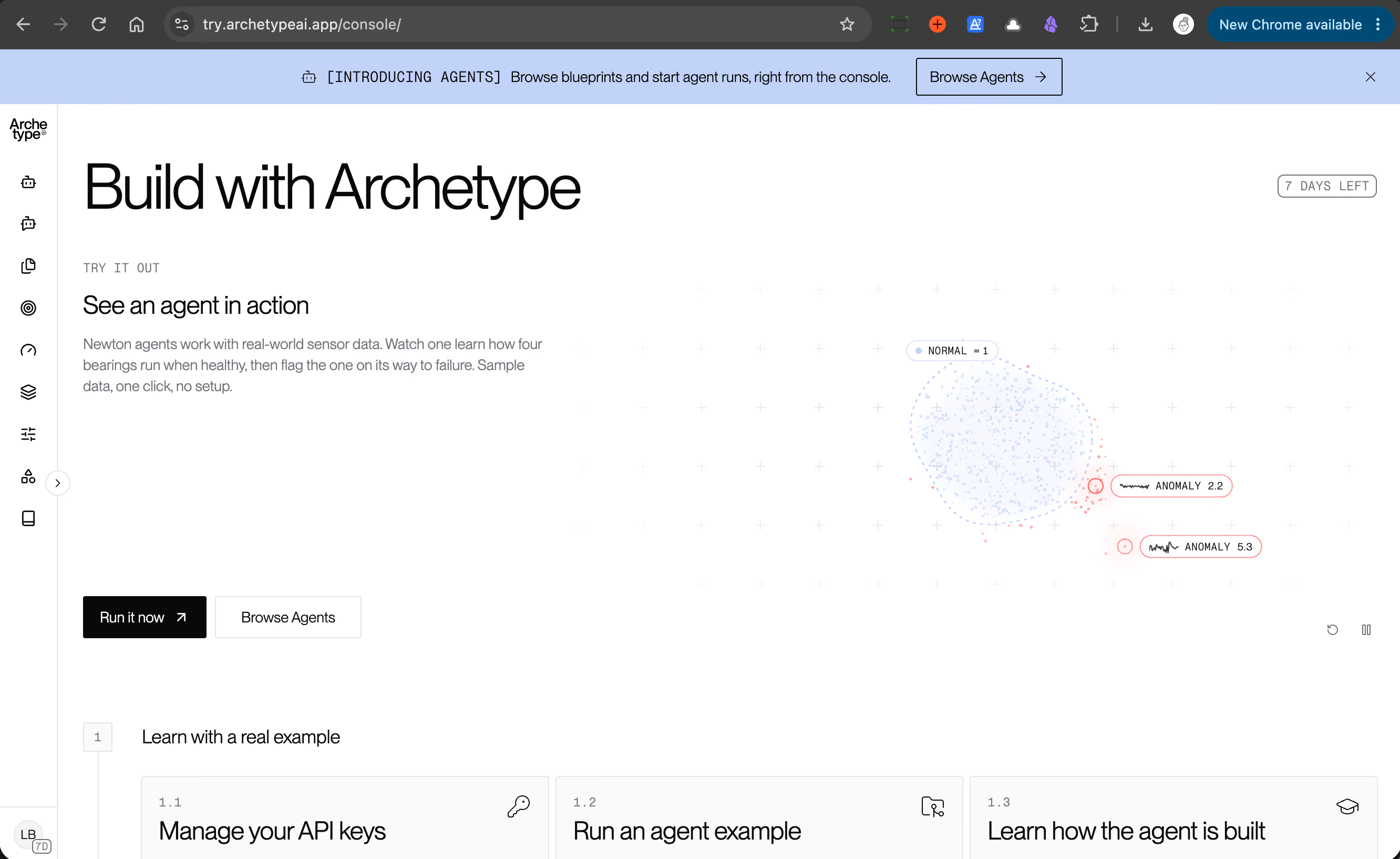
With a 14-day trial on Archetype AI Cloud, you can use Newton, our physical world model, to build an agent for your machines and applications. Newton is already pretrained on physical data, so you don't have to start by building and training a model yourself. Bring your sensor data, choose an agent, and get started in hours.
You can work in Python or use an AI coding agent such as Claude Code, Cursor, or Codex.
Hundreds of developers have already built agents with Newton at our hands-on Newton Meetups, using their own sensor data or public datasets. We've heard from many others who want to try Newton on their own. Now you can.
Request your free trial. We'll set up your organization within one business day.
Build agents in hours, not months
Building a machine learning application for physical systems can take months. Teams often have to collect and label data, develop a model, and repeat the process for every new machine or operating environment.
With Newton, you can start with a pretrained model and focus on the agent and application you're building.
The 14-day trial includes:
- Your own trial organization and Newton API key
- Three Newton Agents: Anomaly Discovery, Operational State Monitoring, and Rare Event Detection
- Batch mode for uploaded files and serving mode for live data
- Eval and Optimize APIs to test agents on your data and improve their performance
- Python support and Agent Skills for Claude Code, Cursor, Codex, Copilot, and more than 20 other coding agents
Coming soon: Task Verification and Manual Generation, which extend Newton Agents to video-based workflows.
For the full list of features, usage allowances, and support hours, see the free trial documentation.
Skip model training and labeling
Newton is a physical world model pretrained through self-supervised learning on billions of cross-modal sensor measurements, including vibration, pressure, temperature, electrical current, and acoustics.
Because Newton has already learned how physical systems behave, you don't need to train a new model for every machine or application. It can work across different machines and operating environments, often without any fine-tuning.
For ML teams, that means:
- Up to 90% accuracy out of the box in customer deployments, without model training.
- Adaptation with as little as a few labeled examples, significantly reducing data requirements.
- 90–95% of use cases in customer deployments required no fine-tuning.
In one manufacturing deployment, a single Newton model worked across different motor types, sizes, and manufacturers without fine-tuning. It also identified gearbox failures that had previously gone undetected.
Instead of spending months developing models for individual machines, your team can spend that time building the applications that use them.
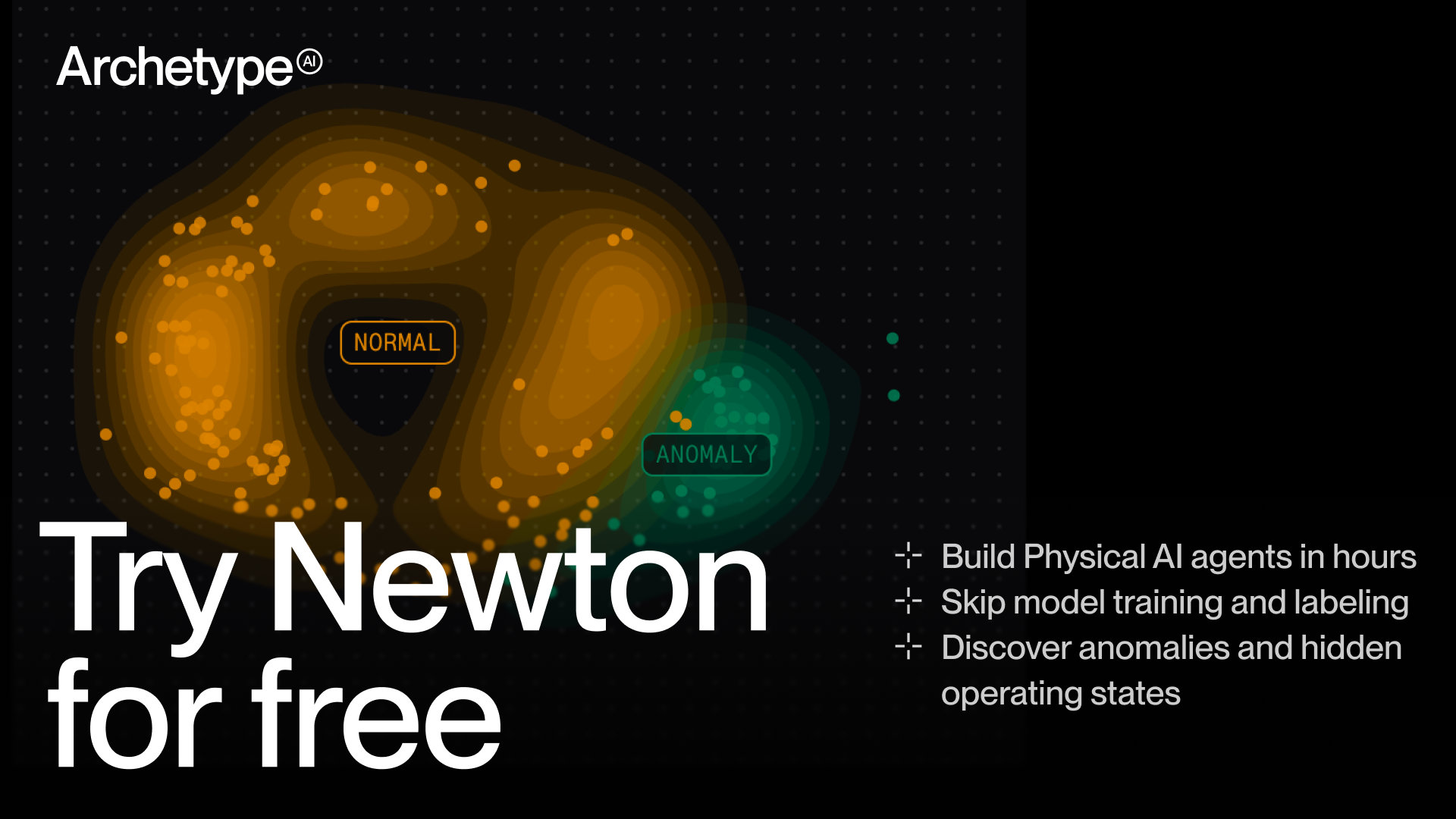
Discover anomalies and hidden operating states
The trial includes three Newton Agents. Each tackles a different problem that teams face when working with sensor data.
Anomaly Discovery. Critical failures are rare, so most assets have little or no labeled failure history to learn from. This agent learns what normal looks like from your data, then discovers novel anomalies and failure modes across complex sensor streams without any labeled failures. It surfaces issues from cross-sensor patterns, so operators can investigate emerging risks before they impact production. Use it to:
- Detect previously unknown equipment issues
- Identify emerging process abnormalities
- Surface novel failure modes
- Monitor assets without labeled failure history
In one wind energy deployment, Newton analyzed 40+ sensors across 63 turbines with no labeled data and found 9 previously unknown failure patterns.
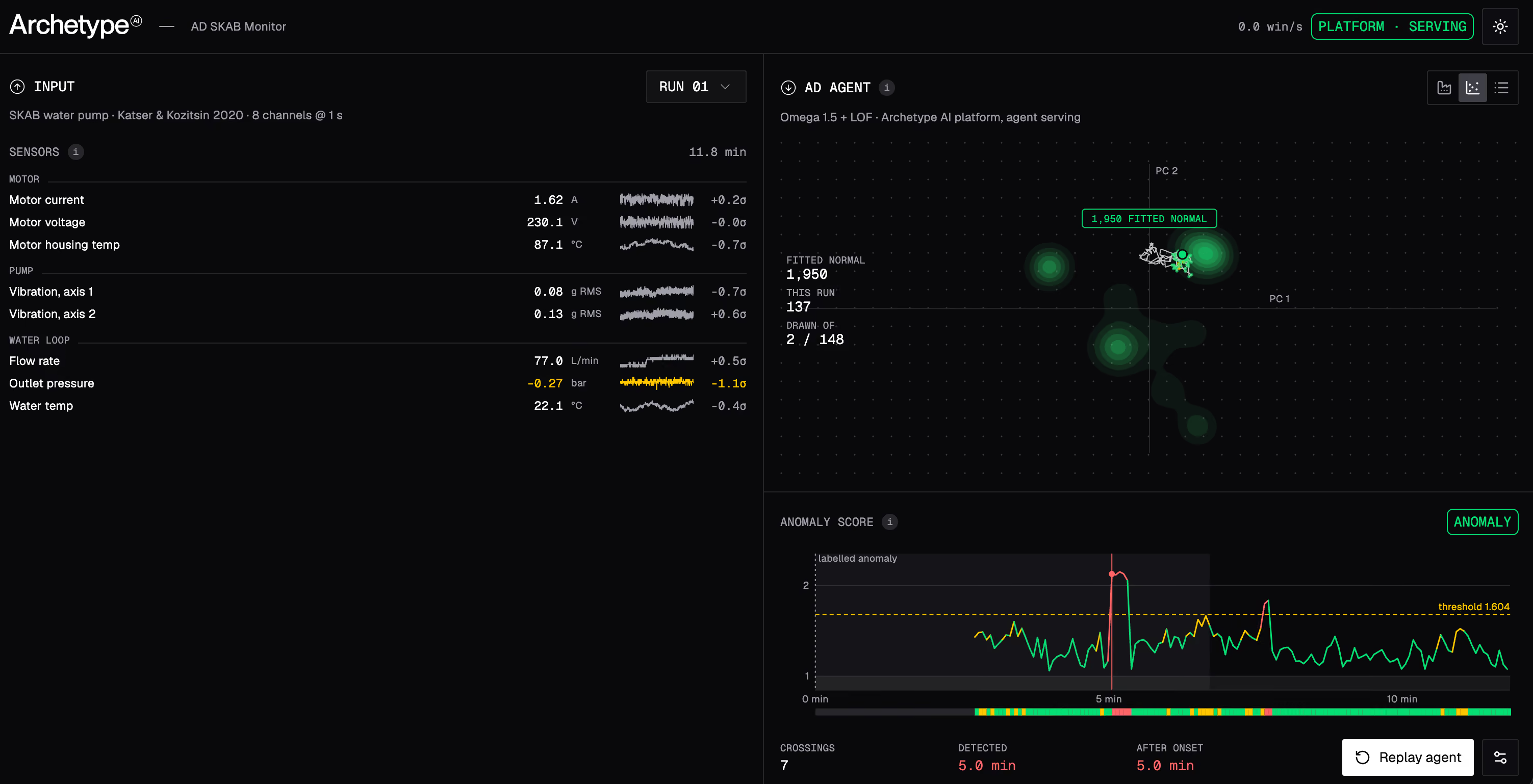
Operational State Monitoring. Machines and processes move between operating states all day, and those states drive reliability, quality, and throughput. Operational State Monitoring continuously identifies changing operating states from multimodal sensor data, giving real-time visibility into machine behavior and surfacing equipment degradation and process instability as they develop. Use it to:
- Monitor asset condition and performance
- Detect process drift and degradation
- Identify and maintain optimal operating envelopes
For an energy producer, Newton separated normal from degraded pump states in real time across hundreds of wells, reaching 90%+ accuracy on classifying pump events from a low-cost edge device at each pump.
Rare Event Detection. The most critical operational events often have very little historical data, which makes them hard for conventional AI to learn. This agent learns the unique patterns associated with known faults, failures, or operational events from just a handful of labeled examples, so teams can identify critical conditions before they become larger operational problems. Use it to:
- Detect known failure modes
- Identify critical operational events
- Monitor infrequent quality or safety issues
- Reduce missed detections despite limited training data
For an oil and gas operator, Newton identified operationally meaningful rig states from surface and downhole sensors with only a handful of examples, reaching 97% accuracy with fine-tuning.
What's next
We're starting with Newton on Archetype AI Cloud and will expand the trial with more agents and deployment options.
- More agents. Task Verification and Manual Generation are coming to the trial, extending Newton to video-based workflows. We'll add more Newton Agents as they become available.
- More deployment options. You'll also be able to evaluate Newton within your own AWS account, so it runs in the environment where your data lives.
Want early access to these capabilities? Talk to our team. You can also build alongside our engineers at the next Newton Meetup.
Bring your sensor data. Build your first agent. See what Newton can find. Try Newton free for 14 days.